

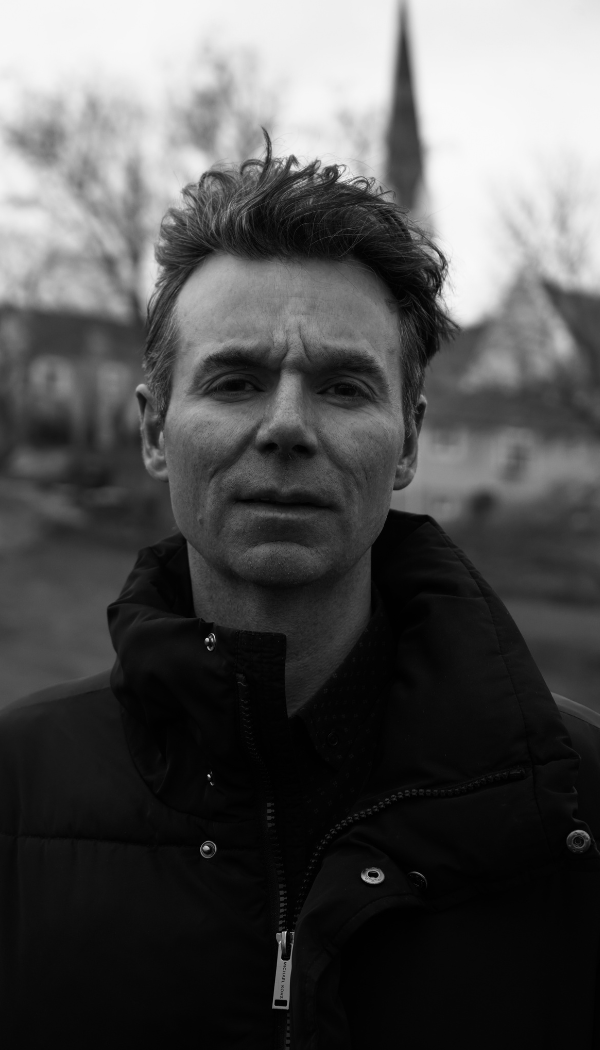
Adam Bailie: Sound, Space, and the Chemistry of Culture
For over two decades, Adam Bailie has operated at the intersection of sound, environment, and human behavior. His creative foundation was built on a strikingly diverse sonic palette. While the hooks of Top 40 radio provided an early masterclass in pop accessibility, his deeper musical education was shaped by his father exposing him to complex polyrhythms and socio-political weight of African icons like Fela Kuti, Youssou N’Dour, and Salif Keita. Balanced by the boundary-pushing jazz of Miles Davis, Louis Armstrong, John Coltrane, Charlie Parker the roots reggae of Bob Marley, and the raw groove of James Brown, Bailie developed an early understanding of music as a visceral, cultural force. Concurrently, the timeless work of master songwriters like Paul Simon, Van Morrison, Dolly Parton, and Carole King instilled in him a deep appreciation for the compelling comfort and emotional architecture of a perfectly crafted song. All rock, dance, and hip-hop genres following the jazz, folk and blues era would simply build off of these core foundations, using technology to innovate new sounds.
This eclectic upbringing laid the groundwork for a 25-year career spent embedded in the live music ecosystem. From sweat-soaked night clubs and local bars to expansive festival stages, Bailie has lived the realities of the music industry from every angle—sharing stages with countless artists, hosting legendary open mic nights in Toronto, and driving the creative energy of live spaces across Canada.
Through these thousands of nights on the ground, Bailie developed a keen, anthropological eye for how music directly influences culture, fashion, and human attitude. He recognizes that sound does not exist in a vacuum; it is explicitly linked to consumer identity. He observes the undeniable connective tissue between the clothes a person wears and the music they consume, or the drink someone orders and the songs that resonate with them.
To Bailie, musical genres possess their own distinct culinary and aesthetic equivalents: standard Top 40 tracks naturally pair with the rapid consumption of fast food and fast fashion, while jazzy house music seamlessly mirrors the sophisticated atmosphere of high-end cocktails and designer shoes. Having spent a quarter-century studying these subtle behavioral cues, Bailie approaches sound not merely as entertainment, but as an intentional design language capable of shaping spaces, moving crowds, and defining local culture.
.
Adam Bailie builds worlds out of words.
Singer-Songwriter
Adam's story actually began right here in Newmarket. Long before he was writing and producing countless songs, he was a local kid with a guitar and a plan. After attending school for music production, co-writing the CHR top 40 hit song "Summer Vibes", and touring Ontario with his musical team, he did what any self-respecting musician does: he headed West to Vancouver to see if the air really tasted like sea salt, cedar and IPA (spoiler: it does).
The next two decades were a blur of Pacific mist, Jericho Beach inspiration, and hauling gear. He paid his dues on legendary stages like the Commodore Ballroom, played for the Winter Olympics athletes (who were much faster than him), and toured everywhere from Halifax to LA. He learned two things on the coast: how to write, produce, and license a song "It's You" for an international marketing campaign and how to sell a Martin D28 during a pandemic.
Eventually, the magnetic pull of York Region traffic brought him back home. Now settled back in Newmarket, Adam is staged at his "Beachhead," plotting a musical revolution fueled by a burning desire for crafting songs and his love of analog gear. He’s traded the mountain views for the quiet precision of Toronto hustle culture, working on Away With Words—a project that’s half music, half "literature," and 100% more complicated than using a laptop and artificial intelligence.
Twenty years of live experience has taught Adam that while you can take the musician out of Newmarket, you can’t take the Newmarket out of the musician. He’s still a storyteller at heart, still obsessed with Martin guitars, and still convinced that everything sounds better when it’s recorded on gear older than he is.